Affichage des articles dont le libellé est iPads. Afficher tous les articles
01:41
 New-age
gadgets such as Apple's iPads and TVS could shortly be rolled up like
newspapers, thanks to a new technology being formulated by scientists in
Australia and Italy.
New-age
gadgets such as Apple's iPads and TVS could shortly be rolled up like
newspapers, thanks to a new technology being formulated by scientists in
Australia and Italy.
Researchers at Australia's Commonwealth Scientific and Industrial Research Organisation, Melbourne University and Italy's University of Padua were making use of laser technology to create products comprising TVs, iPads, cellular phones and Kindles more flexile, thinner as well as affordable.
According to mX, the same technology was also being utilized to build up screens, which would replace light bulbs.
The screens would be fastened to a ceiling like wallpaper to light a room.
The researchers were creating prototypes to take to Apple and other makers by the coming year.
According to Melbourne-based CSIRO researcher Jacek Jasieniak, the technology could effortlessly be applied to iPads to make them more accessible.
Jacek Jasieniak said, "It wouldn't be so bulky. So in the future, they'll make (electronic) newspapers that are flexible and rollable. You'll be able to put them in your bag or pocket and read them on the train in a very compact way. It can be applied to any displays, including mobile phones, where you need some color being emitted maybe (at) a high intensity, brightness and purity."
The laser technology would also dramatically lessen manufacturing costs and make colour displays more lustrous. (With Inputs from Agencies)
New Technology Allows You To Roll Up iPads, TVs Like Newspapers
New Technology Allows You To Roll Up iPads, TVs Like Newspapers
New-age
gadgets such as Apple's iPads and TVS could shortly be rolled up like
newspapers, thanks to a new technology being formulated by scientists in
Australia and Italy.Researchers at Australia's Commonwealth Scientific and Industrial Research Organisation, Melbourne University and Italy's University of Padua were making use of laser technology to create products comprising TVs, iPads, cellular phones and Kindles more flexile, thinner as well as affordable.
According to mX, the same technology was also being utilized to build up screens, which would replace light bulbs.
The screens would be fastened to a ceiling like wallpaper to light a room.
The researchers were creating prototypes to take to Apple and other makers by the coming year.
According to Melbourne-based CSIRO researcher Jacek Jasieniak, the technology could effortlessly be applied to iPads to make them more accessible.
Jacek Jasieniak said, "It wouldn't be so bulky. So in the future, they'll make (electronic) newspapers that are flexible and rollable. You'll be able to put them in your bag or pocket and read them on the train in a very compact way. It can be applied to any displays, including mobile phones, where you need some color being emitted maybe (at) a high intensity, brightness and purity."
The laser technology would also dramatically lessen manufacturing costs and make colour displays more lustrous. (With Inputs from Agencies)
15:41
Mini iPad VS Samsung Galaxy Tab 7.7
he Apple iPad Mini and Samsung Galaxy Tab 7.7. Symbols rivalry raging between the two manufacturers, see which of these tablets we prefer:
galaxy tab vs ipad mini ipad mini apple 265x300 VS Samsung Galaxy Tab 7.7: The comparative

Size: 7.7 inch for Samsung, 7.9 inch iPad mini. A slight difference of 1 cm diagonal that goes unnoticed to use.
Verdict: equality
Applications: With the iPad mini, you can enjoy the 280,000 applications specifically designed for the iPad 10 inches. Samsung does not release figures, but the Android catalog is undoubtedly provided a little less.
Verdict: Apple advantage
Camera: 5 megapixel on the side of the iPad mini, against 3,000,000 on the Galaxy Tab.
Verdict: Apple advantage
Battery: If we refer to manufacturer data, both units display a battery life of 10 hours. In real conditions, everything will depend on the use you make of it.
Verdict: equality
Screen: With its Super AMOLED technology of 1280 x 800, or 196 pixels per inch, the definition of the Galaxy Tab is slightly larger than the iPad mini (163 pixels per inch).
Verdict: Samsung advantage
The connection: tenfold by adding a Micro SD card.
Verdict: Samsung advantage
Conclusion: When comparing these two models only on their technical characteristics, it is very difficult to make out a winner.
If you are already using iOS for your phone, iPad mini will probably be more advisable for the synergy existing between the iDevice (the argument also applies to Samsung). You'll understand, these are purely personal that can tip the balance to one or the other of these tablets.
galaxy tab vs ipad mini ipad mini apple 265x300 VS Samsung Galaxy Tab 7.7: The comparative

Size: 7.7 inch for Samsung, 7.9 inch iPad mini. A slight difference of 1 cm diagonal that goes unnoticed to use.
Verdict: equality
Applications: With the iPad mini, you can enjoy the 280,000 applications specifically designed for the iPad 10 inches. Samsung does not release figures, but the Android catalog is undoubtedly provided a little less.
Verdict: Apple advantage
Camera: 5 megapixel on the side of the iPad mini, against 3,000,000 on the Galaxy Tab.
Verdict: Apple advantage
Battery: If we refer to manufacturer data, both units display a battery life of 10 hours. In real conditions, everything will depend on the use you make of it.
Verdict: equality
Screen: With its Super AMOLED technology of 1280 x 800, or 196 pixels per inch, the definition of the Galaxy Tab is slightly larger than the iPad mini (163 pixels per inch).
Verdict: Samsung advantage
The connection: tenfold by adding a Micro SD card.
Verdict: Samsung advantage
Conclusion: When comparing these two models only on their technical characteristics, it is very difficult to make out a winner.
If you are already using iOS for your phone, iPad mini will probably be more advisable for the synergy existing between the iDevice (the argument also applies to Samsung). You'll understand, these are purely personal that can tip the balance to one or the other of these tablets.
20:11
New Technology Allows You To Roll Up iPads, TVs Like Newspapers
New-age
gadgets such as Apple's iPads and TVS could shortly be rolled up like
newspapers, thanks to a new technology being formulated by scientists in
Australia and Italy.
Researchers at Australia's Commonwealth Scientific and Industrial Research Organisation, Melbourne University and Italy's University of Padua were making use of laser technology to create products comprising TVs, iPads, cellular phonesand Kindles more flexile, thinner as well as
affordable.
According to mX, the same technology was also being utilized to build up screens, which would replace light bulbs.
The screens would be fastened to a ceiling like wallpaper to light a room.
The researchers were creating prototypes to take to Apple and other makers by the coming year.
According to Melbourne-based CSIRO researcher Jacek Jasieniak, the technology could effortlessly be applied to iPads to make them more accessible.
Jacek Jasieniak said, "It wouldn't be so bulky. So in the future, they'll make (electronic) newspapers that are flexible and rollable. You'll be able to put them in your bag or pocket and read them on the train in a very compact way. It can be applied to any displays, including mobile phones, where you need some color being emitted maybe (at) a high intensity, brightness and purity."
The laser technology would also dramatically lessen manufacturing costs and make colour displays more lustrous. (With Inputs from Agencies)
Researchers at Australia's Commonwealth Scientific and Industrial Research Organisation, Melbourne University and Italy's University of Padua were making use of laser technology to create products comprising TVs, iPads, cellular phones
and Kindles more flexile, thinner as well as
affordable.According to mX, the same technology was also being utilized to build up screens, which would replace light bulbs.
The screens would be fastened to a ceiling like wallpaper to light a room.
The researchers were creating prototypes to take to Apple and other makers by the coming year.
According to Melbourne-based CSIRO researcher Jacek Jasieniak, the technology could effortlessly be applied to iPads to make them more accessible.
Jacek Jasieniak said, "It wouldn't be so bulky. So in the future, they'll make (electronic) newspapers that are flexible and rollable. You'll be able to put them in your bag or pocket and read them on the train in a very compact way. It can be applied to any displays, including mobile phones, where you need some color being emitted maybe (at) a high intensity, brightness and purity."
The laser technology would also dramatically lessen manufacturing costs and make colour displays more lustrous. (With Inputs from Agencies)
15:48
Starting at the meat of both systems the Apple iPad mini features an
A5 1GHz processor, the same CPU uses to power its iPad 2. The mini also
features 500MB of RAM. Besting those options is the Nexus 7′s
Tegra 3 processor which features a 1.2GHz quad-core processor that is
powered alongside 1GB of RAM. In this competition the Nexus 7 takes the
win but for “casual” users the difference won’t be noticeable.
 On the display side customers have been complaining about the iPad
mini’s display which is one of the worst in the high-end 7-inch tablet
market. Apple chose to ditch retina and instead offer a 7.9 inch screen
with 1024 x 768 pixels of resolution that outputs at 163 pixels per
inch. On the other hand the 7-inch display of the Google Nexus 7
features a 1280 x 800 pixels output with 216 pixels per inch. Want to
watch HD videos? You’ll want the Nexus 7 and for that matter you’ll want
the Nexus device for video game playing and possibly even just for
casual long-term use.
On the display side customers have been complaining about the iPad
mini’s display which is one of the worst in the high-end 7-inch tablet
market. Apple chose to ditch retina and instead offer a 7.9 inch screen
with 1024 x 768 pixels of resolution that outputs at 163 pixels per
inch. On the other hand the 7-inch display of the Google Nexus 7
features a 1280 x 800 pixels output with 216 pixels per inch. Want to
watch HD videos? You’ll want the Nexus 7 and for that matter you’ll want
the Nexus device for video game playing and possibly even just for
casual long-term use.
From a memory point of view the Google Nexus offers less options with 16GB and 32GB devices up for grabs compared to the iPad Mini’s 16GB, 32GB and 64GB models. Neither device offers SD card support which is mostly a surprise for a Google device considering Apple has never been a fan of that particular expansion format.
If you plan to take photographs with your tablet you’ll also want the iPad mini which features a backside 5-megapixel camera and a front-side 1.2-megapixel option. The Nexus 7 unfortunately only offers a 1.2 megapixel camera on the backside.
Another big consideration for many users will likely be the lack of GPS found on Apple’s Wi-Fi only iPad mini. Apple has never provided GPS on Wi-Fi only iPad devices but with a premium price this is a sorely missed feature.
The biggest draw for many buyers however is likely the price points. While a 16GB version of the Nexus 7 will set you back just $199, you will pay $329 for a similar offering via the iPad mini. If you upgrade to the 32GB nexus 7 you will pay $299, still below the iPad mini’s $329 price point for a simple Wi-Fi only device with 16GB memory. Jump up to a 32GB iPad mini and the premium price skyrockets to $559.
iPad Mini Vs. Google Nexus 7?
iPad Mini Vs. Google Nexus 7?
Apple has finally announced its long-awaited 7-inch iPad mini and while Apple fans are sure to flock over to the device many buyers might find a better deal with the Google Nexus 7. Comparing both devices shows their advantages and disadvantages and leaves customers with a touch choice between two capable devices.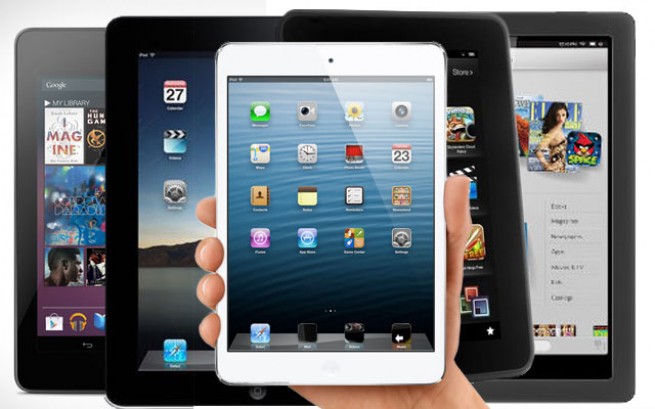
From a memory point of view the Google Nexus offers less options with 16GB and 32GB devices up for grabs compared to the iPad Mini’s 16GB, 32GB and 64GB models. Neither device offers SD card support which is mostly a surprise for a Google device considering Apple has never been a fan of that particular expansion format.
If you plan to take photographs with your tablet you’ll also want the iPad mini which features a backside 5-megapixel camera and a front-side 1.2-megapixel option. The Nexus 7 unfortunately only offers a 1.2 megapixel camera on the backside.
Another big consideration for many users will likely be the lack of GPS found on Apple’s Wi-Fi only iPad mini. Apple has never provided GPS on Wi-Fi only iPad devices but with a premium price this is a sorely missed feature.
The biggest draw for many buyers however is likely the price points. While a 16GB version of the Nexus 7 will set you back just $199, you will pay $329 for a similar offering via the iPad mini. If you upgrade to the 32GB nexus 7 you will pay $299, still below the iPad mini’s $329 price point for a simple Wi-Fi only device with 16GB memory. Jump up to a 32GB iPad mini and the premium price skyrockets to $559.
Inscription à :
Articles (Atom)